


|
*originally issued in 1979, first time on CD w/bonus
*Liner notes by Barton McLean
*English/Japanese texts, lots of photos inside
BARTON McLEAN and PRISCILLA McLEAN, COMPOSERS
Although Barton and his wife Priscilla McLean have had a long and distinguished
history of LP and compact disc albums throughout their professional composer/performer
career, this album is unique in that it is the first one to present, on
one CD, such a broad and comprehensive picture of their purely electronic
music, spanning 1975 through 2001. Interestingly, although their materials
and equipment have changed, their ideas of musical composition are still
basically the same, creating a unity throughout the CD.
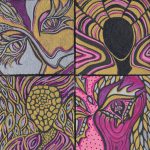
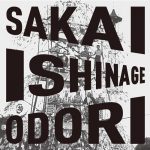
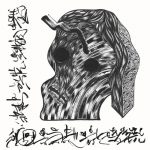
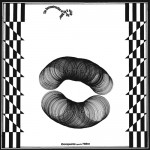
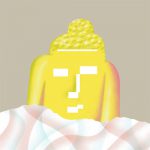
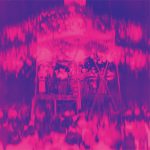
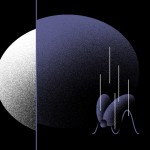
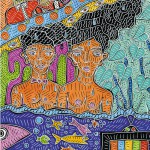
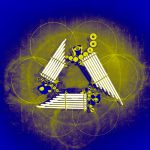
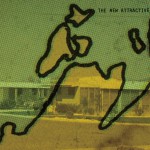
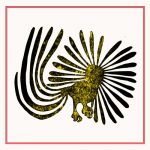
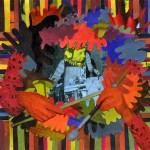
Regarding the graphic score of "Song of the Nahuatl" which comprises
the cover of this CD, Barton McLean and graphic artist Gary Pyle felt a
need to explore the subconscious visual domain suggested by the sounds.
The artistic rendering preserves dynamics, timing, relative high and low
pitch areas, and textural/timbral aspects, while presenting a truly artistic
expression in its own right.
To impart a sense of the meaning and composition of these works, along
with offering a glimpse into the milieu in which they were created, the
following excerpts are quoted here from Priscilla McLean's new autobiography
"Hanging off the Edge :Revelations of a Modern Troubadour", published
by iUniverse (New York, Lincoln, NE, Shanghai) and also available with
corresponding CD, featuring excerpts of her music described in the book,
at: <http://members.cisbec.net/mclmix/hanging.html>
Throughout the time span of the works on this album, Priscilla McLean kept
detailed journals of her experiences, forming the basis of her autobiography.
These excerpts, abridged and slightly altered, are imbedded in the more
specific program notes on each work below.
Book Excerpt: from HANGING OFF THE EDGE, pp. 149 - 159
1973 -1978: South Bend, Indiana to Austin, Texas:
In 1973, Indiana University at South Bend (where Barton McLean taught)
ordered from the EMS Studios in London a Synthi-100 synthesizer and digital
256 sequencer, which comprised the first commercial digital sequencing
capability in the USA. メBy 1971 we had also begun our own home studio,
purchasing a new Arp 2600 Synthesizer and three reel-to-reel tape recorders:
two two-channel half-track Revoxes and a four-channel quarter-track Sony,
and borrowing from the college a small Synthi AKS Synthesizerムan update
of the EMS Putney, with a ribbon keyboard and 256-note real-time sequencer.
When Bart introduced me to the new studio with the Synthi-100, I stared
unbelievingly here was a huge synthesizer, along a whole wall, with hundreds
of push-pins (a matrix setup for connecting sounds, rather than the old
patch cords), and twenty-two oscillators! The Synthi-256 Digital Sequencer
was a full-sized keyboard, standing alone diagonally to the analog synthesizer,
but connected internally.
In that studio with the giant machines, one raced from one end of the room
to another to play and record the sounds, never sitting down, and in removing
unwanted noise or editing out a recorded section, the composer had to take
a metal splicing block and sharp razor blade, and pressing down very hard,
cut through the 1-inch wide acetate tape in two places, remove the unwanted
time segment, and rejoin the two remaining ends with special splicing tapeノSo
we threeミBruce, Bart, and Iミworked all our spare time, alternating with
each other, in the I.U.S.B. Studio. I spent whole days there, sometimes
22 hours long, working and working to get just the right sound-combinations
and record them
The McLean Mix
[NOTE: The McLean Mix, composing/performing duo of Barton and Priscilla
McLean, has toured worldwide since 1974, and annually since 1983.]
メThe McLean Mix was born on September 19, 1974, in our World Premiere concert
at St. Maryユs College, Notre Dame, Indiana. The faculty, of which I was
an adjunct professor, was delighted when I offered to perform with Bart
our new electronic music, consisting of メGone Bananasモ by Bart, as he soloed
on the Arp 2600. This was a light piece, and ended with Bart, having set
the synthesizer to play the music by itself on its sample and hold controller,
sitting on the edge of the stage eating a banana! Second was my Night Images
six-minute stereo tape work. Next came my "Dance of Dawn", 22
minutes long. We finished the evening with a jazzy piece by Bart called
メGrooveモ, which had us jamming on two synthesizers the Arp 2600 for me,
and Bart on the Synthi AKS. These early live-performance compositions suffered
the demise of all such pieces of the period, but fascinated the audience
at the time they who had never heard any live electronic music. The works
for stereo tape lived on, however.
"During the halcyon days of the 70's, when all electronic music was
enthusiastically received and the audiences large and eager, an album produced
out of this concert (CRI SD 335 with Priscilla's "Dance of Dawn"
and Barton's "Spirals") garnered a dozen reviews from all over
America, and the composers were looked upon as courageous explorers into
a vast musical continent unknown and beckoning.
In August of 1976 we moved to Austin, Texas. After the Synthi-100 was removed
from the Indiana University, South Bend Electronic Music Studio in 1974,
we were left with its digital sequencer, a small ElectroComp 101 Synthesizer,
the mini-synthesizer Synthi AKS, and the tape recorders and mixer. This
wasnユt enough to continue any quality work, so we added our own home studio
equipment, and turned back to manipulating found soundsムsteak knives bouncing
on violin strings, tennis balls on the piano harp, banging pots and pans,
etc. All of these sounds in addition to ones from the synthesizers and
sequencer I used in my next major electronic piece, メInvisible Chariotsモ.
Because of the unwieldiness of the musique concrete (recorded, not synthesized,
sounds) medium, composing the piece was glacially slow.
For instance, the first sound is a scrape up a bass piano string with a
metal bar. I wanted the echo from the piano to last over thirty seconds,
so I had to record it onto a master tape, then re-record the echo from
this tape to each of four channels of another tape recorder, recording
each successive one a few seconds ahead of the last one, over and over,
until thirty seconds evolved. Then I combined the beginning piano flourish,
recorded at home, with a similar keyboard flourish created on the Arp 2600
Synthesizer and performed, playing (forwards and backwards) on the Synthi
256 Sequencer. Much more was involved to complete this complex beginning
sound, and two months of timeムfor thirty seconds of music!
メAfter lying low since our performance in the old UT electronic music studio
a few weeks after we arrived in Austin in 1976, The McLean Mix was revived
and had several engagements the spring of 1979. This included Bartユs new
electronic piece メSong of the Nahuatlモ, finishing with my メInvisible Chariotsモ,
with all three movements. This varied according to the audience and schedule.
[end of paraphrased excerpt]
|
|
自然環境、外的要素から得たイメージを音に彫刻するコンポーザー・デュオ、バートンとプリシラのマクリーン夫妻が1979年にフォークウェイズで発表した電子ランドスケープ・アルバム『lectro-Symphonic
Landscapes』の新装CD化。新たに3作品を追加収録し、彼らが長年取り組んできたピュアな電子音楽の全てのエッセンスを網羅。作者自身の選曲/解説/監修で送る完全版仕様。
バートンとプリシラのマクリーン夫妻は今までにそのプロフェッショナルな作曲活動、演奏活動を通して、傑出したLPやCDを発表してきたという長い実績がありますが、この作品が特にユニークなのは、夫妻が1975年から2001年までの間繰り広げてきた広範囲で多岐にわたるピュアな電子音楽の全てのエッセンスを、初めて一枚のCDに包含するという試みです。興味深いことに、彼らの使用楽器や製作環境は変わったにも関わらず、作曲へのアイデアは以前となんら変わっておらず、それが一枚のCDへの統一感を与えています。
このCDのカヴァーデザインを構成している「Song of Nahutal」のグラフィックな譜面に関連して、バートン・マクリーンと、グラフィック・アーティストのゲイリー・パイルは音によって引き起こされる潜在意識の映像的な側面を探求する必要性を感じました。その芸術的解釈は音のダイナミクス、タイミング、可聴外の高、低音のエリア、組織的な音色の様相までを、まったく独自な芸術的表現で具現化しています。
(ライナーノート序文より抜粋)
★ウィリアム・イートン自身による解説(英語/日本語両方での掲載)
★通常ケース仕様/20頁ブックレット封入
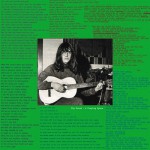
*今回配付のDMポストカードです。

Barton McLean performing live his "Synthiny" at the state-of-the
art Synthi 100 Synthesizer at Indiana University-South bend. 1974 (photo
by Bruce Hemingway).

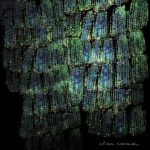
Taken from album cover art in 1970s.
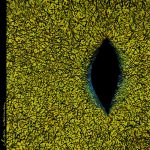
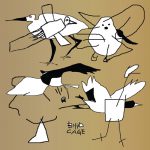
The part from the graphic score of "Song of the Nahuatl", composed
by Barton McLean & drawn by Gary Ryle, 1976.

McLean Mix with their concert featuring "Song of the Nahuatl"
and "Invisible Chariots"
among other works (photo by Neal Sadowsky).
ALSO YOU MAY INTEREST...

=TRACKS=
PRISCILLA McLEAN: INVISIBLE CHARIOTS (1975-77)
1. Voices of the Invisible (6:20)
2. Archangels (08:38)
3. Chariots (06:51)
4. BARTON McLEAN: SONG OF THE NAHUATL (1976) (17:02)
5. BARTON McLEAN: Valley of Lost Dreams from VISIONS
OF A SUMMER NIGHT (1988-89) (09:30)
6. BARTON McLEAN: JOURNEY ON A LONG STRING (2001)
(11:48)
7. PRISCILLA McLEAN: ANGELS OF DELIRIUM (2001) (13:33)
|